Flyingbombsandrockets.com
V1 & V2 strikes on London 1944-5
The V1 flying bomb was the first cruise missile: an unmanned, gyro-guided plane that delivered a ton of high explosives. A total of 2,419 exploded in London between June 1944 and March 1945. The distinctive noise of its pulse-jet engine, which cut out after a predetermined mileage, terrorised the population. They quickly became known as 'Doodlebugs.'


Grove Road London E4 13th June 1944
Gypsy Road Welling after 2 V1s
People in London had become accustomed to the horrors of bombing during the 1940-41 Blitz. Since then, attacks had been more sporadic. There were heavy hit-and-run raids in 1943, and in February 1944, the 'Little Blitz' caused further serious damage and loss of life. After D-Day, there was great relief and expectation that the war would be over quickly. Rumours circulated for some time about Hitler's secret weapons, but civilians took these as a joke. For a year prior to 1944, Bomber Command had been engaged in a campaign to destroy the V1 launch sites in Northern France. This delayed the launch of the first missile by about six months, at the cost of the lives of 2,000 Allied airmen and an unknown number of French civilians in the countryside surrounding the sites. On the night of June 13, 1944, despite these efforts, Londoners heard a strange sound in the sky, described as a motorbike without a silencer or a badly maintained steam train going by. uphill. Some also thought they saw a burning enemy aircraft with a stream of flame emanating from its tail. Others recognised this as the first of the vengeance weapons, code-named "Diver" by British Intelligence. The first V1 dived to the ground and exploded on Grove Road, London E4, at 4:25 a.m. on June 13, 1944. It hit the railway bridge, severely damaging it and the track. Several houses were demolished, and six people were killed. This gave London its first taste of what a V1 could do. This was one of five launches that night—a range-finding exercise by the Nazis. Nothing happened for about 48 hours as they prepared the next wave of the attack
The attack resumed on June 15th, this time with a significantly higher launch rate. In the South London area I examined, there were 2 incidents on 15th, 18 on the 16th, 17 on the 17th, and 28 on the 18th, with many more occurring outside these areas. Throughout the campaign, South and South East London bore the brunt of assaults.
The Guards chapel 18th June 1944
Among potential targets, none would have been for the Luftwaffe than the Guards Chapel, located in Bird Cage Walk, St James, and home to the Royal Guards stationed at Wellington Barracks. The chapel was filled that morning with guardsmen, their families, and friends. Shortly after the began around 11 am, the congregation heard a distant buzzing that intensified into a roar overhead, overpowering the hymn singing. The engine suddenly cut out, and the V1 glided down, impacting on the chapel's concrete roof, which had been rebuilt after suffering damage from incendiary bombs during the Blitz. The V1 exploded upon impact, causing the entire roof to collapse onto the congregation burying rubble up to 10 feet deep. In total, 121 military personnel and civilians lost their lives, and 141 were seriously injured, with only the Bishop of Maidstone escaping unscathed, sheltered from the blast by the portico over the altar where he was conducting the service.


The V1 could kill large numbers of people, inflict severe injuries, and cause devastating damage to buildings. Upon impact, it exploded on the surface, creating a powerful blast wave that radiated outward from the centre. This was followed by a vacuum effect, leading to a second rush of air that produced a destructive push-and-pull effect. The blast radius extended between 400 and 600 yards, completely demolishing buildings at the impact site, with up to 20 terraced houses collapsing in the densely populated inner London suburbs. Brick walls were reduced to rubble, while further from the epicentre, walls, roofs, and window frames were torn away. Even farther out, windows shattered and roofing slates were dislodged, with hundreds of houses damaged by each V1 strike.
The summer of 1944 was cold and wet, and repairs took months, leaving Londoners either homeless or enduring frigid conditions in roofless houses. Those unfortunate enough to be caught by the blast faced horrific injuries or death from flying debris, while others were trapped under collapsed structures. As the attacks progressed, injury patterns shifted; initially, many were caught off guard by flying glass, but they soon sought shelter in safer areas of their homes, resulting in fewer glass injuries but an increase in crush injuries from falling rubble.
Ultimately, approximately 6,184 people were killed by V1s and 17,981 seriously injured, while tens of thousands sustained lesser injuries, and many more endured the grief of losing loved ones or their homes. Evacuation efforts, both official and unofficial, saw approximately 15,000 people leaving London daily by mid-July, with reports of near-panic at major stations as individuals struggled to secure tickets for overcrowded trains. It is estimated that between 1.5 and 2 million people fled the capital during this time, creating a haunting emptiness: children disappeared from the streets, and previously scarce food became more accessible.
For the first time, eight deep-level air raid shelters, completed too late for the Blitz, were opened along the Northern line. These provided refuge for up to 8,000 people each in tunnels such as Belsize Park, Camden Town, Stockwell, Clapham North, Clapham Common, and Clapham South
The Aldwych 30th June 1944
The Aldwych was packed with people during lunchtime when the V1 struck. Others were at their desks, and some of the girls from the Air Ministry were sunbathing on the roof. The modern steel-frame buildings stood up well to the blast, and indeed, much of it was absorbed by the blast wall outside the Air Ministry. This caused the blast to be channelled down the street rather than dissipating in collapsing buildings. Numerous people were mown down, killed, or maimed; more died in the ruins of buses, and the girls on the Air Ministry roof also perished. Some workers at the Air Ministry were sucked out of office windows by the blast and vacuum and died. 48 people were killed, and many more were injured.

Sloane Court Chelsea 3rd July 1944
In terms of fatalities, this was the second-worst flying Bomb incident during the campaign. This was another case of a perfect target (even though it was probably the random act of fate), as the block of flats was filled with American G.I's, the V1 struck at 07.41 am and in the resulting explosion and fire, around 74 service men were killed
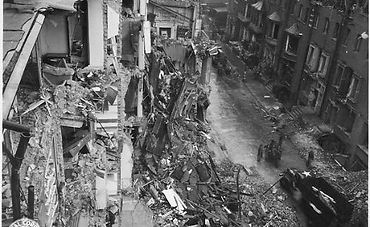
Lewisham High Street 28th July 1944
The V1 exploded on the roof of a shelter outside Marks and Spencer. Major damage was sustained by the shops, including Woolworths and Sainsbury's, as well as by the market. Fifty-nine people died in this tragedy, and a further 124 were very seriously injured—hundreds of others suffered less serious injuries. Casualties occurred in the shops, in the basement café of Woolworths, and on passing buses. The local post office was also badly damaged.
This was the worst single V1 incident in South London. The blast area was particularly large, extending up to 600 yards in each direction. This is indicative of the larger and more powerful warheads used by the Nazis later in the attacks. In total, about 100 shops were severely damaged, alongside flats and houses that suffered varying degrees of damage across a wide area. This section of the High Street was completely rebuilt on both sides of the road after the war
