Flyingbombsandrockets.com
V1 & V2 strikes on London 1944-5
Dulwich SE21 and SE22 suffered disproportionately during this period . German forces erroneously used North Dulwich Station as their mean aiming point, bringing a high concentration of strikes directly into the neighbourhood. In total, Dulwich was hit by 41 V-1 flying bombs and 3 V-2 rockets, causing widespread death, injury, and structural devastation.
Major Incidents in SE21 & SE22
The strikes fundamentally altered the landscape of Dulwich, hitting major landmarks, shopping districts, and residential streets alike.
Friern Road Strike June 20, 1944A V-1 flying bomb struck Friern Road, injuring 30 people and requiring significant post-war clearance.
.Rosendale and Lovelace Road June 23, 1944
A V-1 caused sheer chaos at the junction of Rosendale Road and Lovelace Road, resulting in 6 deaths.
Dulwich College Hit July 10, 1944A
V-1 flying bomb heavily damaged the Southeast End of the historic Dulwich College
Dulwich Picture Gallery July 21, 1944A V-1 strike extensively damaged the famous Dulwich Picture Gallery, requiring major post-war restoration.
Tragedy at the Co-op August 5, 1944On a busy Saturday afternoon, a V-1 struck the Co-operative store on Lordship Lane. This was the worst V-1 tragedy in the area, killing 23 people
. Etherow Street Devastation November 1, 1944A V-2 rocket obliterated Etherow Street (SE22), destroying houses on both sides of the road. This single strike killed 24 people, making it the deadliest local incident.
Court Lane January 1945A V-2 rocket scored a direct hit on 69-81 Court Lane, resulting in 7 fatalities.
Aftermath and Legacy.
The scale of destruction in South London was staggering. An estimated 90% of all houses in the wider Borough of Camberwell (which includes Dulwich) suffered some degree of war damage. The immediate need to re-house residents permanently altered Dulwich's architectural makeup. Local authorities extensively utilised cleared V-weapon sites to build prefabricated housing (prefabs), some of which survived for decades. Where houses were rebuilt to match their original Victorian or Edwardian designs—such as those on Rosendale Road—builders frequently constructed the first floors at slightly lower heights to conserve bricks during severe post-war material shortages.

The Dulwich Picture Gallery 21stJuly 1944


Chaos at the junction of Rosendale Road and Lovelace Road as a result of a Flying Bomb 23rd June 1944 which killed 6 people. The houses have been re-rebuilt to the same design .If you look carefully though you will see their first floor were built to a lower height, probably to spare bricks in the post war shortages.


Looking from South Croxted Road to the Back of the shops in Park Hall Road after a V1 on the 7th July. The photo on the right is from the same spot in 2003.
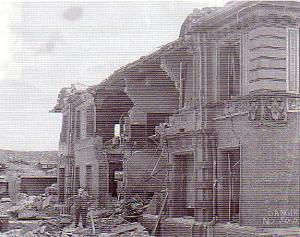
Dulwich College 10th July 1944 after a V1 badly damaged the South East End


Etherow Street SE22. This area was devastated by a V2 on the first November 1944. Both sides of the street suffered major damage and have been totally re-built. 24 people died in this attack

The pictures above show Friern Road SE22 at much the same spot. The first is probably in the 1940's or 50's and the second was taken in 2003 after Local authority housing was built on the site. Many V weapon sites were used by the councils after the war to provided much needed housing. The damage in this road resulted from both a V1 on the 20th of June 1944 which injured 30 people and the Etherow Street V2 as mentioned above.

The V1 Site in Lordship Lane near the Townley Road junction. This was as a result of a Flying Bomb 22nd August 1944 and some of the site still retains prefabs